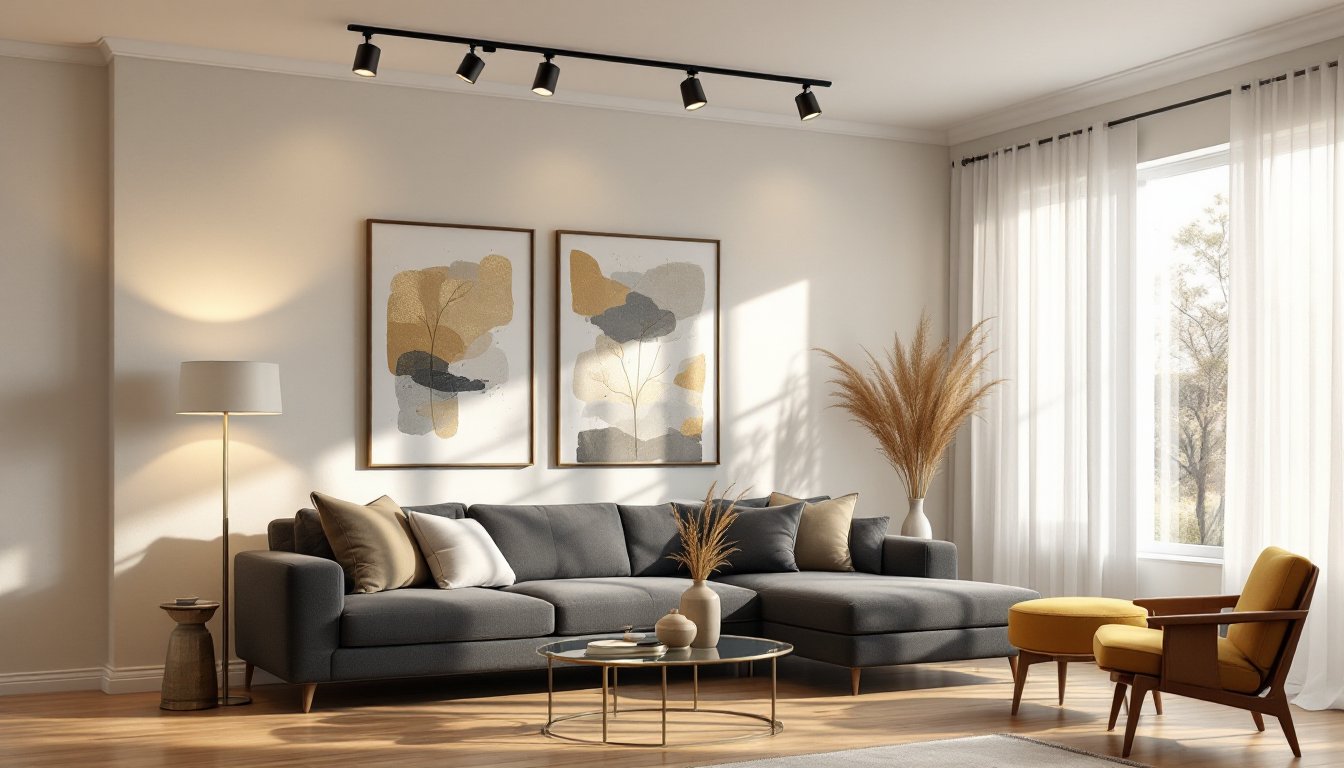
Track lighting has shed its industrial-only reputation and landed squarely in the living room, where it belongs. It offers adjustability that recessed cans can’t match and visual interest that a single pendant lacks. Whether you’re highlighting a gallery wall, balancing ambient light, or simply want to stop rearranging furniture around fixed ceiling fixtures, track systems give you control. This guide walks through practical layouts, finish options, and installation considerations to help you design a track lighting plan that works with your space, not against it.
Table of Contents
ToggleKey Takeaways
- Living room track lighting ideas provide directional control and flexibility that fixed recessed cans cannot match, allowing you to adjust fixture heads independently to highlight artwork, seating areas, or architectural details without calling an electrician.
- Minimalist track lighting layouts work best when positioned 24–36 inches from walls with heads spaced 18–24 inches apart for ambient lighting or clustered 12–15 inches for focused accent zones.
- Proper accent lighting for art requires positioning track fixtures at a 30-degree angle from the wall and using bulbs with a Color Rendering Index (CRI) of 90 or higher to render colors accurately.
- Avoid over-lighting by using only 60–70% of available light sources simultaneously, layering track lighting with ambient base lighting, task lamps, and cove lighting to create depth and prevent harsh spotlight effects.
- Track lighting installation requires connecting to an existing ceiling box, fastening into joists for runs longer than 4 feet, and calculating loads to stay within 80% of the circuit’s capacity per National Electrical Code standards.
Why Track Lighting Works Perfectly for Living Rooms
Living rooms demand flexibility. Seating arrangements shift, art rotates, and task needs change, track lighting adapts to all of it without a service call.
Directional control is the main advantage. Each fixture head pivots and rotates independently, so you can aim light exactly where it’s needed: onto a reading chair, across a textured wall, or into a dim corner. Compare that to a fixed recessed light, which illuminates one spot forever unless you hire an electrician to move the can.
Scalability matters in larger or multipurpose rooms. A single track run can hold anywhere from three to six heads (depending on circuit load and track length), letting you layer light without installing multiple junction boxes. Standard 120V track systems support heads rated up to the circuit breaker limit, typically 15 or 20 amps, but always check the manufacturer’s load specifications.
Low-profile installation keeps ceiling work minimal. Most track systems mount to a standard electrical box and extend along the ceiling surface, so there’s no need to cut multiple holes or retrofit joist bays. For renters or anyone avoiding drywall surgery, that’s a significant win.
Track lighting also simplifies bulb replacement and upgrades. Swap a halogen head for LED, change beam angles, or add a new head mid-track, all without tools in most systems. That modularity future-proofs your lighting as needs and technology evolve.
Modern Minimalist Track Lighting Layouts
Minimalist design calls for clean lines and restrained hardware, track lighting delivers both when you plan the geometry carefully.
Single straight runs work well in rectangular living rooms. Mount a track parallel to the longest wall, positioned about 24 to 36 inches out from the wall surface. This offset lets you angle heads toward seating or architectural details without shadow interference. For a room roughly 12 × 18 feet, a 6-foot or 8-foot track with three to four heads provides even coverage.
Monorail systems suit more sculptural layouts. Unlike rigid straight track, monorail bends into curves and angles, allowing L-shapes, S-curves, or geometric patterns. It’s particularly effective in open-concept spaces where the living area flows into dining or kitchen zones. Keep bends gentle, tight curves can pinch the conductor and create dead spots.
Low-voltage cable systems push minimalism further. Thin horizontal cables suspend individual heads, creating an almost invisible support structure. These systems require a transformer (usually remote-mounted in a closet or basement) and operate at 12V, which limits total wattage but enhances safety and reduces glare with smaller LED sources.
Finish coordination matters in minimalist schemes. Matte black or brushed nickel tracks disappear against dark or neutral ceilings, while white track blends into bright spaces. Avoid mixing metals unless other fixtures (cabinet hardware, door levers) establish a deliberate two-tone palette.
Space heads 18 to 24 inches apart for ambient lighting, or cluster them closer, 12 to 15 inches, when creating a focused pool of light over a specific zone like a console table or sectional. The goal is uniform brightness without obvious hot spots or shadows.
Accent Lighting for Art and Architectural Features
Track lighting excels at highlighting what matters, art, built-ins, textured walls, or statement furniture, without washing the whole room in flat overhead light.
Gallery-style art lighting requires precise aiming. Position track light heads at a 30-degree angle from the wall, measured from the artwork’s center. This minimizes glare on glass or varnish while preventing harsh shadows. For a piece hung at standard height (center at 60 inches above the floor), mount the track about 3 to 4 feet out from the wall.
Beam angle determines coverage. A narrow 15 to 25-degree spot concentrates light on a single canvas or sculpture, ideal for focal pieces. A wider 35 to 50-degree flood washes a larger area, useful for groupings or floor-to-ceiling bookshelves. Many modern LED track heads offer adjustable optics, letting you dial in the spread without swapping the fixture.
Color Rendering Index (CRI) becomes critical when lighting art. Look for bulbs or integrated LED heads rated CRI 90 or higher to render colors accurately. Cheap LEDs with CRI below 80 can shift reds toward orange and blues toward green, dulling the intended palette.
Architectural accents, exposed brick, shiplap, coffered ceilings, or stone fireplaces, benefit from grazing or wall-washing techniques. Mount the track close to the wall (within 12 to 18 inches) and aim heads downward at a steep angle. This rakes light across the surface, emphasizing texture and depth. Contrast this with a direct perpendicular beam, which flattens texture and creates a clinical look.
For built-in shelving or media centers, aim track heads from above at a 45-degree angle to illuminate contents without glare on TV screens. Use dimmers to reduce intensity during movie time, most track systems accept standard dimmers, but verify compatibility with LED drivers to avoid flicker.
Mixing Track Lighting with Other Light Sources
Track lighting shouldn’t shoulder the entire burden, layering multiple sources creates depth and prevents the harsh, spotlight-heavy look that plagued 1990s interiors.
Ambient base layer comes from recessed cans, a central pendant, or wall sconces. These establish overall brightness, while track fixtures add directional accents. In a typical living room, aim for 20 to 30 lumens per square foot of ambient light, then supplement with track heads for an additional 10 to 15 lumens per square foot in task or accent zones.
Table and floor lamps provide localized task lighting for reading or close work. Position them near seating, and angle track heads away from those areas to avoid competing light sources that cancel each other out or create confusing shadows. This also helps with mood lighting control, lamps offer warm, low-level glow for evenings, while track handles brighter activities.
Cove or toe-kick lighting adds an indirect layer that softens the entire space. LED strips hidden behind crown molding or under furniture wash walls and ceilings with gentle illumination, reducing contrast between bright track spots and dark corners. This is especially useful in rooms with high ceilings, where track alone can leave upper walls feeling cavernous.
Dimming and control integration ties everything together. A basic setup uses separate dimmers for track, ambient, and accent circuits. More advanced lighting control systems let you program scenes, “Movie Mode” dims track to 10% and shuts off overhead fixtures, while “Entertaining” brings all layers to 80%. Wireless systems (Lutron Caséta, Legrand Adorne) install without new wiring, a major plus in retrofit situations.
Avoid over-lighting. If every fixture runs at full brightness simultaneously, the room feels like a showroom floor. Designers often recommend using only 60 to 70% of available light sources at any given time, rotating which layers are active based on time of day and activity.
Track Lighting Styles and Finishes to Match Your Decor
Track lighting has evolved far beyond the utilitarian silver rails of the past. Today’s systems span styles from industrial to mid-century to contemporary, each with finish options that integrate, or intentionally contrast, with existing decor.
Industrial styles feature exposed hardware, often in matte black, aged bronze, or raw steel finishes. Fixture heads resemble vintage cinema lights or factory pendants, with mesh cages or barn-door shutters. These pair well with exposed ductwork, brick walls, or reclaimed wood furniture. Look for systems with visible fasteners and chunky knobs, subtlety isn’t the goal here.
Mid-century modern designs lean on geometric shapes and warm metallics. Brass, copper, or brushed gold tracks with spherical or conical heads echo the Sputnik-era aesthetic. These work particularly well in homes with teak furniture, terrazzo accents, or large windows. Many mid-century-inspired systems use Edison-style LED filament bulbs for a retro-modern hybrid look. Platforms like Dwell regularly feature interiors that blend vintage lighting with contemporary layouts.
Contemporary minimalist tracks prioritize disappearing into the architecture. Ultra-thin profiles, seamless connections, and matte white or satin nickel finishes keep the focus on the light itself, not the hardware. Some systems embed LEDs directly into the track rail, eliminating individual heads entirely for a continuous linear glow.
Transitional styles bridge traditional and modern, often using brushed nickel or oil-rubbed bronze finishes with simple cylindrical or bell-shaped heads. These adapt to a wide range of interiors, useful if your living room mixes antique side tables with a modern sectional.
Finish durability varies. Powder-coated aluminum resists scratches and corrosion better than painted steel, and solid brass (not plated) develops a natural patina over time. If the track runs near a fireplace or in a humid climate, verify the finish is rated for temperature swings and moisture exposure.
Match or deliberately contrast the track finish with other metal elements in the room. If door hardware, curtain rods, and lamp bases are all brushed nickel, a matching track creates cohesion. If you want the track to stand out, say, a bold matte black against white ceilings, ensure at least one other element (picture frames, furniture legs) echoes that finish to avoid a floating, disconnected look.
Installation Tips for Living Room Track Lighting
Track lighting installation ranges from straightforward to complex, depending on existing electrical infrastructure and the system type chosen. Safety and code compliance aren’t optional, track systems pull significant current, and improper connections cause tripped breakers or fire hazards.
Shut off power at the breaker, not just the wall switch, before starting work. Use a non-contact voltage tester to confirm the circuit is dead. Track lighting typically connects to an existing ceiling box, but verify the box is rated for the fixture’s weight, lightweight track heads on a single rail rarely exceed 10 pounds total, but heavier systems or long runs may require a fan-rated or heavy-duty box.
Mounting surface matters. Track systems fasten directly to drywall with toggle bolts or into ceiling joists with wood screws. For runs longer than 4 feet, locate and fasten into at least one joist to prevent sagging over time. A stud finder marks joist locations, joists typically run 16 inches on center in modern construction. If the desired track path crosses joists perpendicularly, you’ll have multiple fastening points. If it runs parallel between joists, plan to use heavy-duty drywall anchors rated for 50 pounds or more per anchor.
Wiring connections follow standard practices: black (hot) to black, white (neutral) to white, and bare copper (ground) to the green screw or bare wire. Most track systems include a power-feed connector that mounts to the ceiling box first, then the track rail clips or locks into that connector. Double-check polarity, reversed wiring won’t necessarily trip a breaker but can cause dimming issues or LED flicker.
Track length and expansion joints: Straight track sections typically come in 2-foot, 4-foot, or 8-foot lengths. Join sections with locking connectors, ensuring conductors inside the track align. Some systems allow track cuts to custom lengths using a hacksaw, deburr cut edges and verify the conductor strip isn’t damaged.
Load calculations prevent overloading the circuit. A standard 15-amp, 120V circuit provides 1,800 watts of capacity, but the National Electrical Code (NEC) requires continuous loads (anything running more than three hours) stay below 80% of that, 1,440 watts. Five LED track heads at 12 watts each total only 60 watts, well within limits. Older halogen heads at 50 watts each would total 250 watts for five heads, still safe, but it adds up faster.
Permits and inspections: Most jurisdictions consider adding a new track run to an existing circuit a minor alteration that doesn’t require a permit, especially if you’re replacing an old fixture. Installing a new circuit or relocating a junction box usually does. Check local building codes, when in doubt, file for a permit. It’s cheap insurance and ensures your work meets code, which matters for homeowner’s insurance claims and resale.
PPE and safety: Wear safety glasses when drilling overhead (debris falls into eyes easily) and use a sturdy ladder with a stable, level base. If working near HVAC ducts or in a space with limited ventilation, a dust mask prevents inhaling drywall dust or insulation fibers.
Once installed, test each head position and aim before finalizing. Walk through the room at different times of day and adjust beam angles as needed. Track systems shine (literally) because they’re adjustable, don’t lock everything down until you’ve lived with the layout for a few days.
Conclusion
Track lighting turns living rooms into flexible, well-lit spaces that grow with your needs. Invest time in layout planning and finish selection, and you’ll end up with a system that highlights what matters while staying out of the way. Whether you’re aiming spotlights at art or washing walls with texture-enhancing grazes, the directional control and scalability of track systems offer a practical, design-forward solution that fixed fixtures simply can’t match.