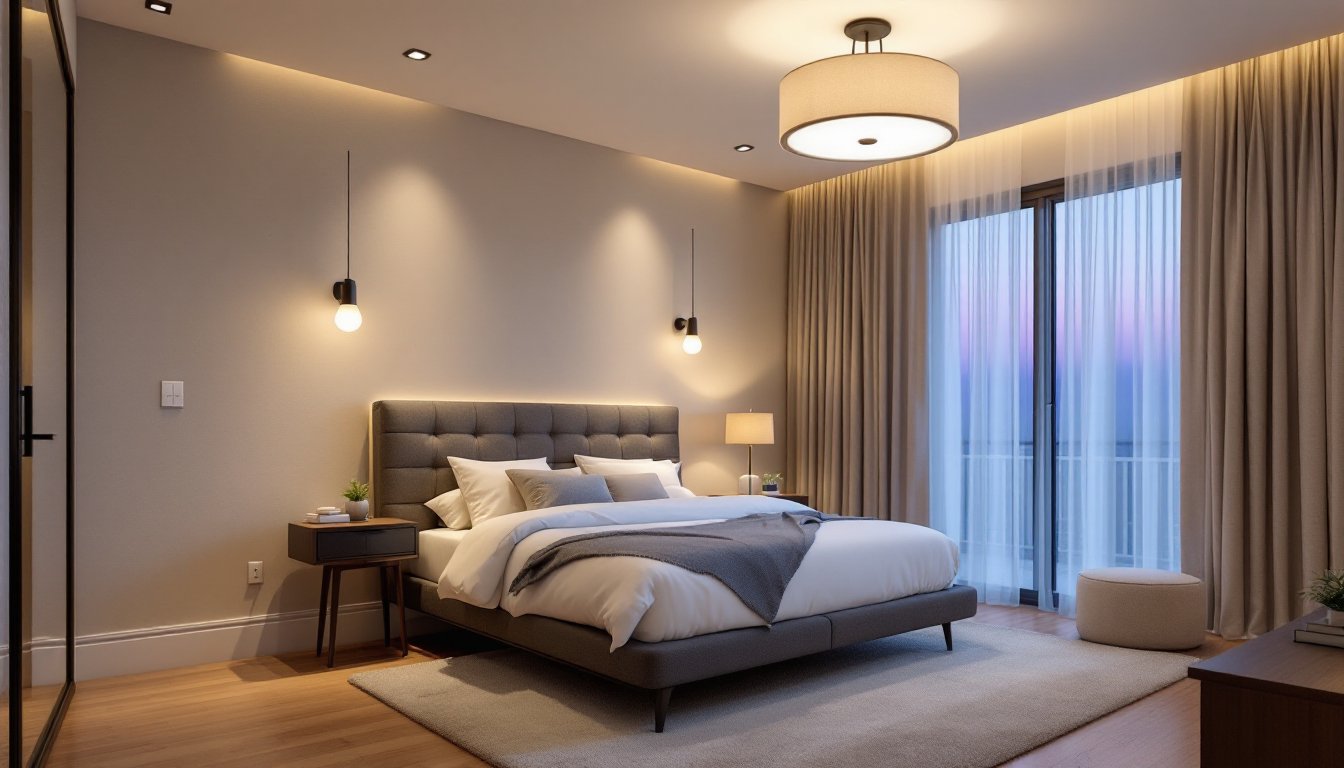
Good bedroom lighting isn’t just about being able to see, it’s about creating a space where you actually want to spend time. Too harsh, and you’re living in a clinic. Too dim, and you’re fumbling for your alarm clock every morning. Ambient lighting strikes the balance, providing soft, general illumination that makes a bedroom feel comfortable without glare or harsh shadows. Whether renovating an older home or fine-tuning a new build, understanding how ambient lighting works and how to install it properly can transform a bedroom from functional to genuinely restful. This guide walks through the fixture types, technical specs, installation steps, and layering strategies needed to get it right.
Table of Contents
ToggleKey Takeaways
- Bedroom ambient lighting balances soft, general illumination to create comfort without glare, serving as the foundation for both functionality and mood.
- Recessed ceiling lights spaced 4 to 6 feet apart and wall sconces are popular ambient lighting fixture options, with LED bulbs at 2700K to 3000K offering optimal warmth for relaxation.
- Aim for 20 to 30 lumens per square foot in your bedroom—a 12×12-foot room needs approximately 2,880 to 4,320 lumens total distributed across ambient fixtures.
- Installing a dimmer switch dramatically improves bedroom ambient lighting by allowing adjustment from full brightness for daytime activities to a gentle glow for evening relaxation.
- Layer ambient lighting with task lighting (bedside lamps, vanity fixtures) and accent lighting (LED strips, uplights) on separate switches for maximum flexibility and visual depth.
- Always verify electrical code compliance, use IC-rated recessed housings when insulation is present, and consult a licensed electrician for complex wiring or circuit upgrades.
What Is Ambient Lighting and Why Does Your Bedroom Need It?
Ambient lighting is the base layer of illumination in any room, the general, overhead light that lets you move around safely and see the space as a whole. It’s not focused on a specific task like reading or applying makeup: it’s the foundation that other light sources build on.
In a bedroom, ambient lighting serves several purposes. It provides enough visibility for daily activities like making the bed, getting dressed, or tidying up. It also sets the overall mood and atmosphere, which is critical in a space designed for rest and relaxation. Unlike kitchens or workshops where bright, task-focused light dominates, bedrooms benefit from softer, more diffused ambient sources that don’t strain the eyes before sleep.
Most building codes don’t mandate specific ambient lighting levels for bedrooms (unlike egress or smoke detector requirements under the International Residential Code), but functional illumination is still essential. A bedroom without adequate ambient light feels cramped and unwelcoming, while one with poorly chosen fixtures can feel sterile or overly bright.
The key is choosing fixtures that distribute light evenly across the ceiling and walls, minimizing shadows and hotspots. Proper lighting control systems allow homeowners to adjust brightness throughout the day, supporting both morning routines and evening wind-down.
Best Types of Ambient Lighting Fixtures for Bedrooms
Choosing the right fixture depends on ceiling height, room size, and whether the wiring already exists or needs to be added. Each option has trade-offs in installation complexity, light distribution, and aesthetic.
Recessed Lights and Ceiling-Mounted Options
Recessed lighting (also called can lights or downlights) remains one of the most popular choices for ambient lighting in bedrooms, especially in newer construction or remodels where ceiling access is available. Standard 6-inch housings provide broad, even coverage and work well in rooms with 8- to 9-foot ceilings.
Installing recessed lights requires cutting into the ceiling and running electrical cable from a switch or junction box. In retrofit scenarios, remodel housings with integrated clips make installation easier by securing to the drywall rather than requiring framing support. Always verify clearance for insulation contact, IC-rated housings are required when insulation will touch the fixture, per National Electrical Code (NEC) standards.
Spacing matters. A common rule of thumb is to place recessed lights about 4 to 6 feet apart, depending on the ceiling height and beam angle of the bulb. Too far apart, and you get dark zones: too close, and the effect becomes spotty rather than ambient.
Flush-mount and semi-flush ceiling fixtures are simpler alternatives. They attach directly to a standard electrical box and don’t require cutting into the ceiling. These work well in rooms with existing overhead wiring or lower ceilings where recessed cans would feel too recessed. Look for fixtures with diffusers or frosted glass to spread light evenly rather than creating a bright center point.
For modern setups, many homeowners integrate these with Bluetooth lighting for wireless control and color-tuning capabilities.
Wall Sconces and Pendant Lights
Wall sconces offer indirect ambient light by bouncing illumination off walls and ceilings. They’re ideal for bedrooms where ceiling fixtures aren’t feasible or where a softer, more decorative look is preferred. Sconces are typically installed 60 to 66 inches from the floor, depending on bed height and wall layout.
Wiring for sconces usually requires fishing cable through walls, which can be challenging in finished rooms without attic or crawlspace access. In homes with existing bedside outlets, an electrician can often tap into those circuits, but verify that the circuit can handle the additional load, 15-amp bedroom circuits are standard, and adding multiple sconces shouldn’t exceed 80% of capacity under NEC guidelines.
Pendant lights can also serve as ambient sources when hung with diffusing shades or globes. They work especially well in bedrooms with higher ceilings or over seating areas. The bottom of a pendant should hang at least 7 feet above the floor to avoid head clearance issues, and the fixture should be centered or positioned to balance the room’s layout.
Both sconces and pendants benefit from dimming capability, which allows adjustment from bright morning light to a gentle evening glow. Installing a dimmer-compatible fixture from the start saves the hassle of retrofitting later.
How to Choose the Right Color Temperature and Brightness
Color temperature and lumens determine how a bedroom feels and functions. Get these wrong, and even the best fixtures will create an uncomfortable environment.
Color temperature is measured in Kelvins (K). For bedrooms, the sweet spot is typically 2700K to 3000K, which produces a warm white light similar to incandescent bulbs. This range promotes relaxation and doesn’t interfere with melatonin production the way cooler, blue-toned light does. Avoid bulbs above 3500K unless the bedroom doubles as a workspace, higher temps feel clinical and can disrupt sleep patterns.
Some modern LED bulbs offer tunable white features, allowing adjustment from warm (2200K) to neutral (4000K) depending on the time of day. These are useful in multipurpose bedrooms but add complexity and cost.
Brightness is measured in lumens, not watts (watts measure energy consumption, not light output). A standard bedroom needs roughly 20 to 30 lumens per square foot for ambient lighting. For a 12×12-foot bedroom (144 square feet), that’s approximately 2,880 to 4,320 lumens total, distributed across all ambient fixtures.
If using four recessed lights, aim for bulbs in the 700 to 1,000 lumen range each. For a single ceiling fixture, a 3,000-lumen bulb works well, but only if paired with a dimmer to avoid over-illumination in the evening.
LED bulbs are the practical choice for ambient lighting. They last 15,000 to 25,000 hours, use a fraction of the energy compared to incandescent or halogen options, and generate minimal heat. Check the CRI (Color Rendering Index), aim for a rating of 80 or higher to ensure colors look natural rather than washed out.
Remember that dimmers and smart controls work best with dimmable LED bulbs. Not all LEDs dim smoothly, and mismatched components can cause flickering or buzzing. Verify compatibility before purchasing.
Installing Dimmer Switches and Smart Lighting Controls
A dimmer switch is one of the simplest upgrades that dramatically improves bedroom ambient lighting. It allows adjustment from full brightness for cleaning or getting dressed down to a soft glow for evening reading.
Standard rotary or slide dimmers are straightforward to install and cost between $15 and $40 depending on wattage rating. Most bedrooms use 600-watt or 1,000-watt dimmers, but LED-specific dimmers are rated by the number of bulbs rather than wattage due to lower power draw. A typical LED dimmer handles up to 150 watts or about 10 to 15 LED bulbs.
Installation requires basic electrical skills and a few tools: a screwdriver, wire stripper, voltage tester, and needle-nose pliers. Always turn off power at the breaker before starting. Remove the old switch, verify no voltage with a non-contact voltage tester, then connect the dimmer’s wires, typically a ground (green or bare copper), and two travelers (usually black, but sometimes red or other colors depending on circuit configuration).
If the bedroom has a three-way switch setup (controlled from two locations), you’ll need a compatible three-way dimmer for one location and a standard three-way switch or companion dimmer for the other. Wiring gets more complex here: if uncertain, hiring a licensed electrician is worth the $75 to $150 service call.
Smart dimmers and switches integrate with home automation systems like Alexa, Google Home, or Apple HomeKit. These allow voice control, scheduling, and remote adjustment via smartphone. Popular models include Lutron Caseta, Leviton Decora Smart, and TP-Link Kasa.
Smart switches typically require a neutral wire (white) in the electrical box, which isn’t always present in older homes. If there’s no neutral, look for switches that work without one (some Lutron models do) or have an electrician run a new cable.
Some homeowners pair smart bulbs with standard switches instead, but this creates a problem: if someone turns off the wall switch, the smart bulb loses power and can’t be controlled remotely. Smart switches solve this by keeping power flowing to the bulbs while controlling brightness and on/off functions digitally.
For those exploring comprehensive solutions, mood lighting setups often combine smart dimmers with color-changing LEDs for maximum flexibility.
Layering Ambient Lighting With Task and Accent Lights
Ambient lighting alone rarely creates a complete, functional bedroom. Layering combines ambient, task, and accent lighting to address different needs throughout the day and add visual depth.
Task lighting focuses light where specific activities happen, reading in bed, working at a desk, or getting ready at a dresser. Bedside lamps, adjustable wall-mounted reading lights, and vanity fixtures fall into this category. These should be brighter than ambient sources but positioned to avoid glare. For bedside reading, 400 to 600 lumens at 3000K works well without disturbing a partner.
Accent lighting highlights architectural features, artwork, or decor. This includes picture lights, LED strip lighting behind headboards, or small uplights in corners. Accent fixtures are typically lower wattage, 100 to 200 lumens, and serve aesthetic rather than functional purposes.
The key to effective layering is independent control. Each layer should operate on its own switch or dimmer so they can be adjusted separately. For example, ambient overhead lights might be dimmed to 30% in the evening while a bedside reading lamp stays at full brightness.
In practice, a well-layered bedroom might include:
- Four recessed ceiling lights (ambient) on a dimmer
- Two bedside table lamps or sconces (task)
- LED strip lighting behind a headboard or under floating nightstands (accent)
- A pendant or small chandelier over a seating area (ambient + decorative)
This setup allows maximum flexibility, bright, even light for cleaning and organizing, focused light for reading or working, and soft, low-level light for winding down before sleep.
When planning circuits, avoid overloading a single breaker. A 15-amp circuit at 120 volts can handle 1,800 watts total, but electricians typically design for 80% capacity (1,440 watts) to prevent nuisance tripping. If combining multiple layers, consider splitting lighting across two circuits or upgrading to a 20-amp circuit if code allows.
Resources like MyDomaine and Design Milk offer visual inspiration for layered lighting layouts, while comprehensive ambient lighting guides provide additional technical detail.
Safety note: Always wear safety glasses when drilling into ceilings or walls to install fixtures, and use a stud finder to avoid accidentally cutting into joists or striking hidden wiring or plumbing. If a project involves running new circuits or working inside the main electrical panel, hire a licensed electrician. Bedroom lighting upgrades are manageable DIY projects for most homeowners, but knowing when to call a pro is part of doing the job right.