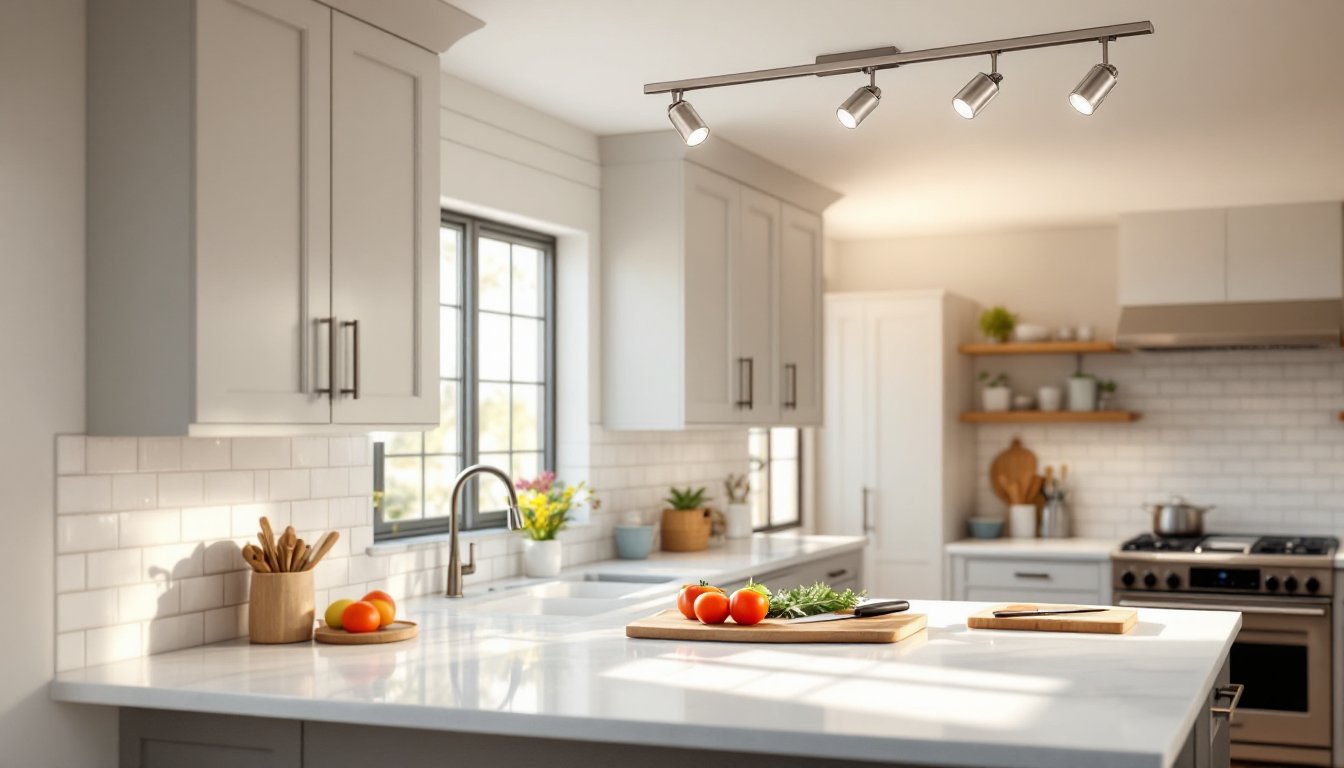
Track lighting has quietly become one of the smartest choices for kitchens that need flexible, focused illumination. Unlike fixed ceiling fixtures that cast light from a single point, track systems let homeowners direct light exactly where it’s needed, over countertops, islands, or that dim corner where the mixer lives. It’s particularly useful in kitchens with evolving layouts or multiple work zones. This guide walks through everything from system types and installation basics to design strategies that maximize both function and style.
Table of Contents
ToggleKey Takeaways
- Kitchen lighting track systems offer flexible, repositionable illumination that adapts to multiple work zones and evolving layouts without requiring full rewiring.
- Track lighting comes in three main types (H-type, J-type, and L-type)—verify compatibility before purchasing replacement heads, as they are not interchangeable.
- Proper placement and support are critical: mount track 18-30 inches from walls depending on ceiling height, secure every 16-24 inches with joists, and never rely solely on drywall anchors for long sections.
- Layer kitchen lighting by combining track fixtures for task lighting with ambient and accent sources to eliminate dark spots and reduce glare from granite or quartz countertops.
- LED heads are the optimal choice for kitchen track lighting due to their long lifespan (25,000+ hours), low power consumption, and ability to support dimming when paired with LED-compatible dimmers.
- Avoid common installation mistakes including incompatible system selections, insufficient support, poor wire management, and oversized beam spreads that create shadows rather than useful task lighting.
What Is Track Lighting and Why It Works Perfectly in Kitchens
Track lighting consists of a linear channel (the track) mounted to the ceiling or wall, with movable light fixtures (heads) that attach at any point along the track. The track itself is electrified, so each head draws power directly from it, no need to hardwire every fixture separately.
Kitchens benefit from this flexibility more than almost any other room. Task lighting needs shift depending on whether someone’s prepping vegetables at the island, cooking at the range, or loading the dishwasher. Track systems let homeowners reposition heads as layouts change or add extra fixtures without rewiring.
Most track lighting operates on 120V household current, though low-voltage systems (typically 12V) exist and require a transformer. Standard line-voltage systems are simpler to install for DIYers since they connect directly to existing junction boxes. Low-voltage options offer more compact, focused beams, ideal for accent lighting, but add complexity and cost.
Another advantage: track lighting doesn’t require recessed cans. In kitchens with limited ceiling depth (common in older homes or below second floors), cutting large holes for recessed fixtures isn’t always feasible. Track mounts surface-level, making it a practical retrofit option.
Types of Kitchen Track Lighting Systems to Consider
Three main track systems dominate the residential market, and they’re not interchangeable. Heads designed for one system won’t fit another, so choose carefully.
H-type track (also called single-circuit track) is the most common and affordable. It powers all fixtures on the track simultaneously, one switch controls everything. It’s fine for kitchens where uniform lighting works, but lacks zoning flexibility.
J-type track and L-type track are less common proprietary systems. J-type is often associated with Juno brand fixtures, while L-type appears in some Lightolier products. Both function similarly to H-type but use different connector shapes. Verify compatibility before buying replacement heads.
Flexible track (sometimes called monorail or cable track) uses a bendable rail that curves around architectural features or follows custom paths. It’s more expensive and typically requires professional installation, but offers design freedom that straight track can’t match. Useful in kitchens with angled ceilings, soffits, or when lighting needs to follow a curved island.
Multi-circuit track systems allow independent control of different fixture groups on the same track. For example, three heads over the island can be on one switch, while two over the sink are on another. This requires track with multiple conductors and compatible heads, check specs carefully. These systems cost more but deliver superior control in larger kitchens.
Most DIY-friendly track kits include straight sections (commonly 4 feet or 8 feet long), connectors for corners or extensions, and a power feed that connects to the ceiling junction box.
Choosing the Right Track Lighting for Your Kitchen Layout
Start by mapping task zones. In a typical kitchen, priority areas include:
- Countertop prep zones: Need 50-75 foot-candles (fc) of task lighting
- Range and cooktop: Often require 70-80 fc for safe cooking
- Sink area: 40-50 fc for dishwashing and cleanup
- Islands and peninsulas: 50 fc minimum, more if used for detailed tasks
Track placement depends on ceiling height and work surface depth. For standard 8-foot ceilings, mount track 18-24 inches out from wall cabinets to avoid shadows cast by cabinet faces. If ceilings are 9-10 feet, increase that distance to 24-30 inches and use higher-lumen heads or add more fixtures.
Galley kitchens often work best with a single track running down the centerline. Position heads to angle toward each counter, avoiding glare from reflective surfaces.
L-shaped and U-shaped kitchens may need multiple track runs or corner connectors. Installing individual tracks on separate switches for each leg gives better control than one long continuous run.
Open-plan kitchens with islands benefit from dedicated track directly above the island, positioned so heads light the work surface without shining into diners’ eyes if the island doubles as a breakfast bar. Aim for fixtures 30-36 inches above the island surface.
Bulb type matters. LED heads are the default choice in 2026, they run cool, last 25,000+ hours, and draw minimal power. Look for heads with CRI (Color Rendering Index) of 90 or higher for accurate color when evaluating food. Color temperature between 2700K-3000K provides warm light similar to incandescent bulbs, while 3500K-4000K gives a crisper, more commercial feel. Some homeowners prefer the modern aesthetic of integrated lighting control systems that allow dimming and scene programming.
Installation Tips for DIY Kitchen Track Lighting Projects
Track lighting installation is straightforward if an existing ceiling junction box is already in place. If not, adding a box requires running new cable through the ceiling, often a job for an electrician unless the attic above is accessible.
Safety first: Turn off power at the breaker, not just the switch. Use a non-contact voltage tester to confirm the circuit is dead before touching any wires.
Tools and Materials Needed:
- Track lighting kit (track, heads, power feed connector)
- Wire stripper and screwdriver
- Drill and bits appropriate for ceiling material
- Toggle bolts or screw anchors (if not hitting joists)
- Wire nuts and electrical tape
- Voltage tester
- Stepladder
- Safety glasses and work gloves
Step-by-Step Installation:
-
Locate the junction box. Most kitchens have a centered box where an old fixture hung. Track doesn’t need to be centered, it should align with task areas.
-
Attach the power feed connector. This piece connects track to the junction box. Secure it to the box with screws provided, then connect wires: black (hot) to black, white (neutral) to white, and ground wire (bare or green) to the ground screw or wire in the box. Use wire nuts and wrap connections with electrical tape.
-
Mount the track. Snap or twist the track onto the power feed connector (mechanism varies by brand). Extend the track toward its end position and mark screw holes. If the track runs perpendicular to ceiling joists, you can screw directly into joists every 16 inches or 24 inches. If running parallel or if joists aren’t accessible, use toggle bolts rated for at least 15 pounds each.
-
Add extensions or connectors if using multiple track sections. Most systems use straight connectors, L-connectors, or T-connectors. Ensure they’re fully seated and conductors make contact.
-
Install track heads. Twist or slide heads onto the track (varies by system type). Position them roughly where needed, you’ll fine-tune later.
-
Restore power and test. Flip the breaker back on and turn on the switch. Adjust head angles to eliminate glare and dark spots.
Permit note: In most jurisdictions, replacing an existing light fixture doesn’t require a permit. But, running new circuits or adding junction boxes typically does. Check local code. If the project involves opening walls or ceilings, or if you’re uncomfortable working with live wiring, hire a licensed electrician. The National Electrical Code (NEC) requires all connections to be made inside approved boxes, no splicing inside walls or ceilings.
Track that crosses open ceiling space (between joists) needs adequate support. Don’t rely solely on drywall anchors for long, heavy track. Consider adding blocking between joists if access allows.
Design Ideas and Placement Strategies for Maximum Impact
Track lighting doesn’t have to look industrial or sterile. Modern systems come in finishes like brushed nickel, matte black, oil-rubbed bronze, and even polished copper. Match track finish to cabinet hardware and faucet finishes for a cohesive look.
Layering light is key in kitchen design. Track handles task lighting, but pair it with ambient sources (recessed cans, flush-mounts, or pendants) and accent lighting (under-cabinet strips or in-cabinet LEDs) for a balanced scheme. Design platforms like Houzz showcase thousands of kitchen lighting combinations for inspiration.
Highlighting focal points: Adjustable track light heads excel at accenting open shelving, glass-front cabinets, or artwork. Use narrow-beam heads (15-25 degrees) for spotlighting and wider floods (40-60 degrees) for general task lighting.
Avoiding glare: Position heads so the bulb isn’t visible from typical sight lines, standing at the sink, sitting at the island, or entering through the doorway. Angling heads at 30-45 degrees relative to the work surface reduces reflections on glossy countertops like granite or quartz.
Track as a design element: In contemporary or industrial-style kitchens, exposed track can be an intentional design feature. Pair matte black track with Edison-style LED filament bulbs for a modern loft vibe. In traditional kitchens, white or brushed nickel track blends into the ceiling more subtly.
Multi-level kitchens: If the kitchen opens to a dining area with a lower or vaulted ceiling, track can follow the angle. Flexible track systems handle slopes and curves better than straight rigid track.
Kitchen remodeling resources on sites like The Kitchn often feature track lighting used creatively in small or oddly shaped spaces where recessed cans won’t fit. In narrow galley kitchens, a single track centered overhead with three or four adjustable heads often outperforms a pair of fixed ceiling fixtures.
Common Mistakes to Avoid When Installing Track Lighting
Using incompatible heads and track. H, J, and L systems aren’t interchangeable. Buying a bargain head that doesn’t fit wastes time and money. Stick with the same brand or verify cross-compatibility.
Insufficient support. Long track sections (over 4 feet) need multiple mounting points. Drywall anchors alone won’t hold heavier multi-head systems. Hit ceiling joists or add blocking.
Ignoring beam spread. A narrow spotlight aimed at a 3-foot countertop creates a small bright circle surrounded by shadow. Use medium-flood or adjustable-beam heads for task areas and reserve spots for accents.
Poor wire management at the power feed. Loose wire nuts or inadequate electrical tape can lead to arcing or shorts. Always secure connections tightly and ensure no bare wire is exposed.
Overloading the circuit. Track lighting typically draws modest power, but verify the circuit’s capacity. A 15-amp kitchen circuit can handle about 1,800 watts total (including other devices on that circuit). Five LED heads at 10 watts each only draw 50 watts, leaving plenty of headroom. But, older halogen systems drew much more, double-check if retrofitting.
Forgetting to account for cabinet shadows. Track mounted too close to the wall leaves countertops in shadow cast by upper cabinets. The general rule: mount track 1/3 of the distance from the wall to the opposite counter edge.
Not testing angles before final tightening. Once track is secured and heads installed, adjust each head individually with the lights on. What looks right from the ladder often doesn’t from standing height.
Skipping the dimmer. Track lighting benefits enormously from dimming capability, especially in kitchens that transition from task-heavy cooking to ambient dining. Ensure both the switch (use a LED-compatible dimmer) and the heads support dimming, not all LED fixtures do.
For additional guidance on fixture selection and layout, design-focused platforms like Remodelista offer curated case studies showing both successful installs and lessons learned from problem projects.
Conclusion
Track lighting remains one of the most adaptable solutions for kitchen illumination. Its ability to reposition and refocus light as needs change makes it especially valuable in active, evolving spaces. With careful planning around task zones, proper installation techniques, and thoughtful design choices, track systems deliver both function and style, without the commitment and cost of recessed lighting.