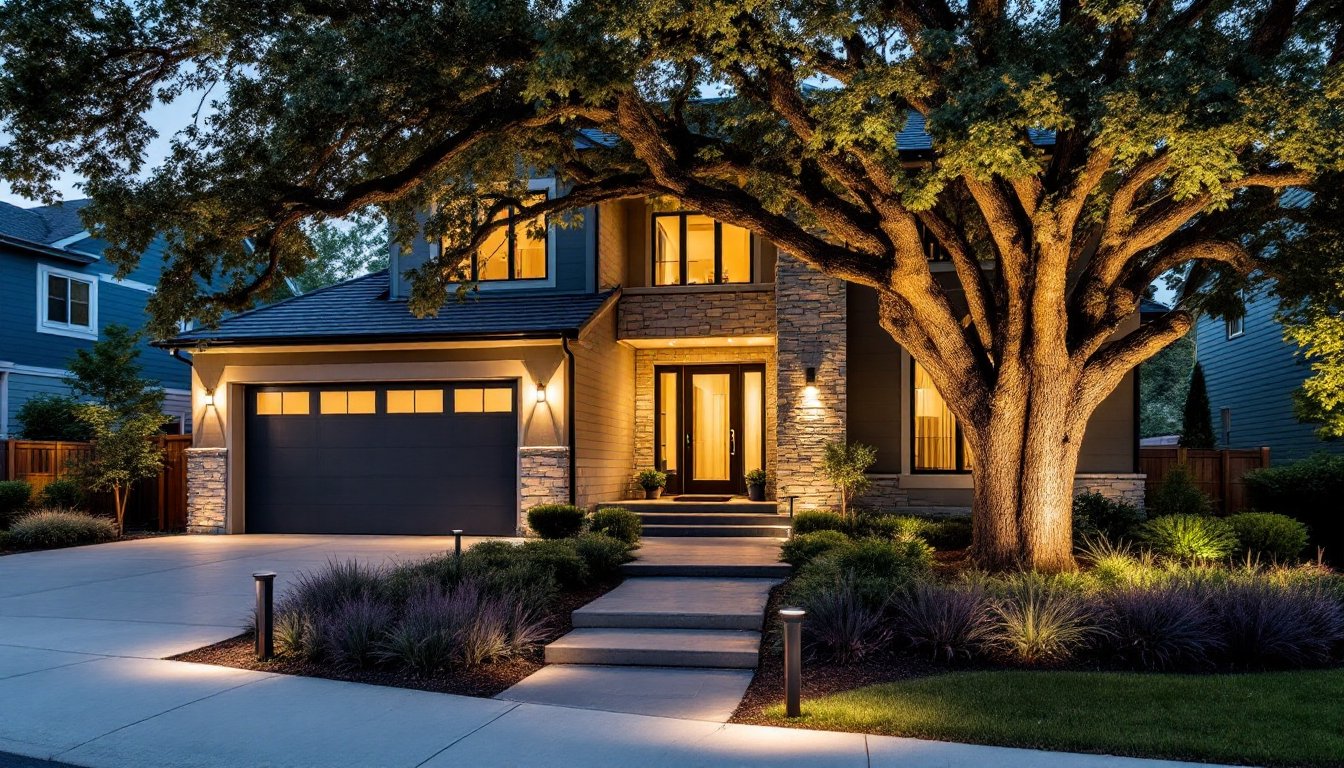
Most homeowners spend thousands on hardscaping, plantings, and architectural details, then flip a single flood light on and call it done. Strategic landscape lighting transforms that investment into a 24-hour asset, but only if fixtures land in the right spots. Poor placement creates glare, washes out features, and leaves pathways shadowed. The difference between amateur and professional results often comes down to six inches and a 15-degree angle shift. This guide walks through where to position each fixture type for safety, curb appeal, and the kind of depth that makes neighbors slow down on evening walks.
Table of Contents
ToggleKey Takeaways
- Strategic landscape lighting placement serves three critical functions—safety, security, and aesthetics—with proper positioning making the difference between professional results and amateur mistakes.
- Path lights should be spaced 8 to 10 feet apart on straight walkways, staggered on alternating sides, and mounted 18 to 24 inches off the edge at a 60-degree angle to minimize glare.
- For trees and focal points, position uplighting fixtures 6 to 12 inches from single-trunk trees and use narrower beam angles (10-25 degrees) to shoot through branches rather than splashing the trunk.
- Security lighting at entry doors requires downlights mounted 7 to 9 feet high to achieve 5 to 10 foot-candles at ground level, while motion sensors should be positioned 6 to 8 feet high angled downward at 45 degrees.
- Common placement mistakes like overlighting, ignoring beam angles, and lighting from a single direction flatten features and create glare—prioritize quality fixture placement over quantity.
- Test landscape lighting angles at dusk with a flashlight before installation and maintain consistent color temperature (2700K–3000K for warm residential looks) to avoid a disjointed appearance.
Why Strategic Landscape Lighting Placement Matters
Outdoor lighting placement isn’t about quantity, it’s about layering and intent. A well-placed uplighting fixture at the base of a tree trunk creates drama: the same fixture three feet away just lights the grass.
Proper placement serves three functions: safety (illuminating trip hazards and entryways), security (eliminating blind spots around entry points), and aesthetics (creating focal points and depth). These roles often overlap. A path light keeps guests from twisting ankles while also guiding sight lines toward a specimen plant.
Most DIY lighting fails come from treating fixtures like porch lights, stick ’em up and hope for the best. Landscape lighting works more like stage lighting: each fixture has a job, and placement dictates whether it performs or just adds glare. The goal is to see the effect of the light, not the fixture itself. That means accounting for beam angles, mounting heights, and sightlines from multiple vantage points (driveway, street, main windows).
Before driving a single stake, walk the property at dusk with a handheld spotlight or smartphone flashlight. Test angles. Note which features pop and which wash out. This 20-minute exercise prevents a dozen repositioning sessions after installation.
Essential Areas to Light Along Pathways and Walkways
Path lights serve two masters: navigation and ambiance. For safety compliance, the Illuminating Engineering Society (IES) recommends a minimum of 0.5 foot-candles along pedestrian paths, enough to see surface changes and edges without tripping.
Spacing matters more than fixture count. Position path lights 8 to 10 feet apart along straight walkways, tightening to 6 feet on curves where sightlines shorten. Stagger fixtures on alternating sides rather than lining them up like runway lights. This creates a more natural flow and reduces the “airport strip” effect.
Mount fixtures 18 to 24 inches off the path edge, aimed slightly downward. If the beam hits the path at a 60-degree angle or steeper, it minimizes glare while maximizing coverage. Avoid centering fixtures in planting beds where mulch settles and stems grow, place them at the bed’s front edge for consistent performance.
For steps, light from above or to the side, never from below (creates a trip hazard by obscuring the tread edge). A shielded step light recessed into a riser or a low-profile fixture on the adjacent wall works best. On stairs with more than three risers, light every step or every other step depending on riser height.
Consider bollard lights (12 to 24 inches tall) for wider walkways or modern aesthetics. They cast a broader pool but need tighter spacing, 6 to 8 feet, because the light source sits higher and creates more pronounced shadows.
Highlighting Architectural Features and Focal Points
Uplighting and accent lighting turn flat facades into dimensional showcases. The key is distance and angle: too close, and you get a harsh wash: too far, and the beam dissipates before hitting the target.
For columns, pillars, and vertical features, position the fixture 12 to 18 inches from the base, aimed straight up. This grazes the surface and emphasizes texture, critical for brick, stone, or stucco. On features wider than 12 inches, use two fixtures flanking the column at 45-degree angles to eliminate the center shadow.
Wall washing (evenly lighting a large surface) requires fixtures placed 24 to 36 inches from the wall with wider beam spreads (60 degrees or more). For a two-story facade, you’ll need fixtures with enough throw distance, typically 20 to 35 watts for LED equivalents, and may need to mount them farther out to avoid hot spots at the base.
Statuary and focal points demand precision. Place the fixture at ground level if the piece has interesting base details: elevate it on a riser or mount it in adjacent hardscape if the face or upper portions deserve emphasis. Aim for a 30 to 45-degree angle to the subject’s center. Avoid lighting straight-on, side or three-quarter lighting creates shadows that define form.
For entryways and front doors, flank the doorway with downlights mounted on the wall or soffit, 5 to 6 feet high. This provides task lighting for keys and locks while framing the entry. Supplement with an uplight on nearby plantings or a column to add depth. Many outdoor design projects layer multiple fixture types at entries to balance function and aesthetics.
Best Spots for Tree and Garden Bed Lighting
Trees are the backbone of most landscape lighting designs, they provide vertical drama and year-round structure. Placement depends on the tree’s form and your sightlines.
For single-trunk deciduous trees, place one fixture 6 to 12 inches from the base, aimed straight up into the canopy. Adjust distance based on spread: narrow trees (dogwoods, serviceberries) need closer placement: wide canopies (oaks, maples) need more distance to capture breadth. Use a narrow beam (10 to 25 degrees) to shoot light through the branches rather than splashing the trunk.
Multi-trunk or clumping trees (birches, crape myrtles) benefit from two fixtures positioned at 90 degrees to each other, capturing both the front and a side profile. This reveals the branching structure and eliminates the flat, cardboard-cutout look that single-source lighting creates.
For evergreens and dense specimens, back off to 18 to 24 inches and use a medium beam (35 to 45 degrees) to light the full form. Evergreens don’t offer the same airy canopy, so the goal shifts from uplighting branches to defining the silhouette.
Garden beds and shrubs need subtlety. Tuck small accent lights (1 to 3 watts) behind or between plants to create depth without overwhelming the blooms. Position fixtures 6 to 10 inches into the bed, aimed at a 45-degree angle toward the focal plant. Layer lighting at multiple heights if the bed includes ornamental grasses or tall perennials, low lights catch foliage, while mid-height fixtures (mounted on stakes at 18 inches) graze taller stems.
Avoid lighting every plant. Select one to three focal specimens per bed and let the rest fall into soft shadow. This contrast is what professionals use to create the “wow” factor most DIY installs lack. When planning garden lighting schemes, experienced designers light what moves or changes, grasses that sway, trees with seasonal color, or specimens with architectural form.
Security and Safety Lighting Placement
Security lighting overlaps with aesthetic lighting but demands brighter output and coverage of entry points and blind spots. The National Electrical Code (NEC) doesn’t mandate outdoor lighting placement, but local ordinances often regulate light trespass and fixture shielding, check with your building department before installing high-output fixtures near property lines.
Prioritize all entry doors, garage doors, and gates. Downlights mounted 7 to 9 feet high on the wall or soffit provide the best coverage. Aim for 5 to 10 foot-candles at ground level, bright enough to see faces clearly on security cameras. Avoid uplighting near doors: it creates facial shadows that obscure identification.
Motion-activated fixtures belong at side yards, back entries, and other low-traffic zones where constant lighting isn’t needed. Position sensors to cover approach paths, not the street or neighboring yards (false triggers annoy everyone). Mount sensors 6 to 8 feet high, angled downward at 45 degrees, with a detection range that stops 3 to 5 feet short of the property line.
For driveways, place low-level lights (bollards or stake lights) along the edges at 10 to 15-foot intervals. This defines the driving surface without creating glare for drivers. If the driveway curves, tighten spacing on the inside of the curve where headlights don’t reach.
Dark corners and blind spots near fences or dense plantings need low-wattage fill lighting. A 3 to 5-watt spot tucked into landscape or mounted low on a fence post eliminates hiding spots without creating a floodlit yard. Use shielded fixtures to direct light downward and avoid spill into neighbors’ windows.
If integrating with security cameras, position lights to eliminate backlight (where the light source sits behind the subject) and glare (direct light into the lens). Side lighting or lighting from the camera’s perspective works best.
Common Placement Mistakes to Avoid
Overlighting tops the list. More fixtures don’t equal better results, they create glare, light pollution, and a stadium effect. A typical front yard needs 6 to 12 fixtures depending on size and complexity. If you’re using more than that, you’re likely redundant.
Fixture visibility ruins otherwise solid designs. If you see the bulb or light source from common sightlines (driveway, street, front windows), it needs repositioning, a shield, or a different fixture. Light should draw the eye to the subject, not the source. When reviewing landscape lighting approaches, professionals emphasize concealment as much as placement.
Ignoring beam angle leads to wasted light. A narrow 15-degree spot on a wide tree trunk lights a stripe, not the canopy. A wide 60-degree flood aimed at a narrow column spills light everywhere but the target. Match beam width to subject width from the fixture’s distance. Most manufacturers provide beam spread charts, use them.
Inconsistent color temperature creates a disjointed look. Stick with one color temp across the entire install: 2700K to 3000K for warm residential lighting, or 3500K to 4000K if you prefer a crisper, modern look. Mixing temps makes the yard look like a lighting showroom floor.
Lighting from one direction flattens features. Even simple designs benefit from cross-lighting: two fixtures at different angles on a tree, or path lights staggered rather than lined up. Depth comes from shadow, and shadow requires light from multiple points.
Skipping junction box planning creates maintenance headaches. Low-voltage lighting uses a transformer, typically mounted near the house or garage. Plan wire runs before placing fixtures, 12-gauge wire handles up to 200 watts at 100 feet: 10-gauge extends that to 150 feet. If fixtures land too far from the transformer, voltage drop dims the farthest lights. Use a photometric calculator or consult the transformer’s manual to map wire runs that deliver consistent voltage.
Conclusion
Landscape lighting placement is equal parts geometry and restraint. The best designs light what matters, hide the fixtures, and leave room for shadow to do its work. Walk the property at dusk, test angles before committing, and remember that six well-placed fixtures outperform twenty scattered ones. If the result draws attention to the house, trees, and hardscape, not the lights themselves, it’s working.