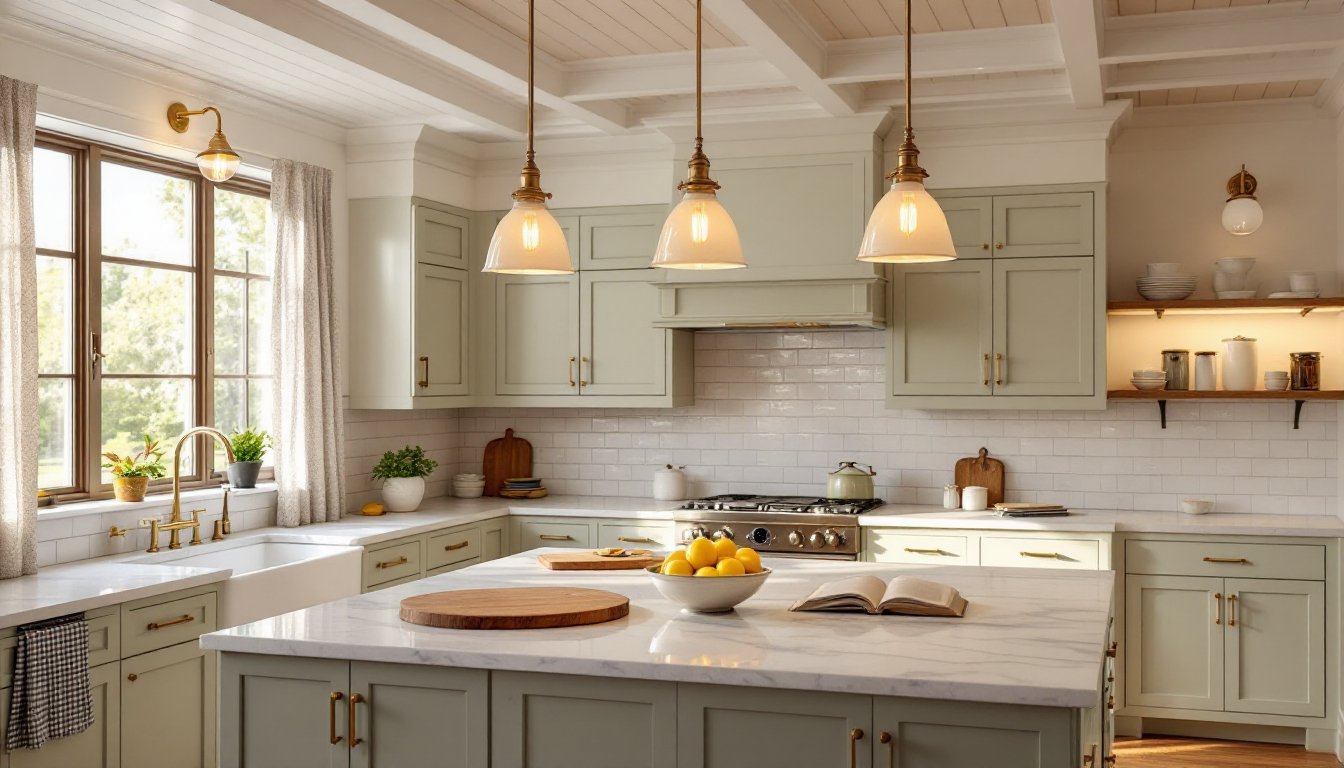
Vintage kitchen lighting isn’t just about nostalgia, it’s a design strategy that brings character, warmth, and visual interest to what’s often the most functional room in the house. Whether you’re renovating a 1920s bungalow or adding soul to a builder-grade kitchen, vintage-style fixtures offer something new construction pendants can’t: personality. They work equally well in period-appropriate restorations and as contrast pieces in modern spaces. This guide walks through what defines vintage lighting, which styles hold up in real-world kitchens, and how to choose, install, and source fixtures that’ll last another century.
Table of Contents
ToggleKey Takeaways
- Vintage kitchen lighting adds character and warmth to any kitchen by using authentic materials like porcelain, brass, and milk glass, with modern reproductions offering the same aesthetic while meeting current electrical codes.
- Industrial farmhouse and Art Deco styles are the most popular vintage kitchen lighting choices, with gooseneck pendants and schoolhouse globes working especially well over islands and breakfast nooks.
- Plan pendant installation 30–36 inches above countertops for task lighting, match fixtures to existing hardware finishes, and ensure at least 50 lumens per square foot of work surface for proper illumination.
- Authentic vintage fixtures require professional rewiring ($40–$80 per piece) due to deteriorating rubber insulation, while modern reproductions from retailers like Rejuvenation and Schoolhouse Electric provide safe, code-compliant alternatives.
- Architectural salvage yards, online marketplaces like Etsy and Chairish, and local estate sales offer affordable authentic vintage kitchen lighting ($40–$200), though shipping and restoration costs should factor into your budget.
What Makes Kitchen Lighting “Vintage”?
“Vintage” in lighting typically refers to fixtures manufactured before the 1980s or modern reproductions that faithfully replicate earlier design eras. Authentic vintage pieces date from roughly 1900 to 1979, spanning everything from Victorian gas-electric conversions to 1970s globe pendants.
Key characteristics include materials like porcelain, milk glass, brass, copper, and cast iron, not the powder-coated aluminum common in contemporary fixtures. Glass shades often feature seeded, ribbed, or hand-blown textures. Hardware shows patina or verdigris, though that can be stripped and refinished if needed.
Construction quality is the giveaway. Vintage fixtures used heavier-gauge metal, solid brass sockets (not plastic), and cloth-covered or early rubber wiring. If the fixture has original wiring, plan to rewire it, rubber insulation deteriorates and becomes a fire hazard. Most electricians can rewire a pendant or sconce for $40–$80 per fixture, depending on complexity.
Reproductions (sometimes called “vintage-style” or “retro”) mimic these aesthetics but use modern components: UL-listed parts, grounded wiring, and LED-compatible sockets. They’re safer out of the box and usually easier to install, but they lack the quirks, and the bragging rights, of a true antique. For a kitchen that’ll see daily use, a well-made reproduction often strikes the best balance between charm and code compliance.
Popular Vintage Kitchen Lighting Styles
Industrial Farmhouse Fixtures
Barn lights, gooseneck pendants, and cage fixtures dominate the farmhouse-industrial crossover. These originated in early 20th-century factories and agricultural buildings, where durability trumped aesthetics. Porcelain enamel shades in white, black, or dark green are period-correct: powder-coated steel is a modern substitute.
Gooseneck arms (the curved metal pipe extending from a wall or ceiling) add dimension and can be angled to direct task light over sinks or islands. Barn lights typically use 14-inch to 18-inch diameter shades: anything smaller reads more country-cute than authentic industrial.
Cage fixtures, wire or metal guards around exposed bulbs, work well over islands or in pantries. They’re forgiving with bulb choice: vintage-style Edison filament LEDs (now widely available at 2700K–2200K color temperature) deliver the look without the 60-watt energy draw. Check that the cage is removable for bulb changes: some cheaper reproductions trap the bulb.
Art Deco and Mid-Century Modern Designs
Art Deco (roughly 1920s–1930s) emphasizes geometric shapes, chrome or nickel plating, and frosted or etched glass. Schoolhouse globes, those ribbed or opal glass spheres, are textbook Deco and still widely reproduced. Paired over a kitchen island, they add symmetry without fussiness.
Mid-century modern fixtures (1940s–1960s) lean toward clean lines, Sputnik-style arms, and materials like teak, walnut, or spun aluminum. Pendant shades in this era often feature dome or cone profiles, sometimes with punched metal or perforated patterns to diffuse light. Originals from manufacturers like Lightolier or Artemide command high prices, but companies like Schoolhouse Electric and Rejuvenation offer faithful reproductions that meet current electrical codes.
Both styles work best in kitchens with 9-foot or higher ceilings. Deco fixtures can feel heavy in low-ceilinged spaces: mid-century pendants often hang on adjustable cords or rods, giving you some control over proportion.
How to Choose the Right Vintage Lighting for Your Kitchen
Start with scale and placement. A 10×12-foot kitchen needs different lighting than a 15×20-foot space with an island. For island pendants, the general rule is one fixture per 2 feet of island length, or a single large fixture (20+ inches wide) centered over shorter islands.
Measure ceiling height to pendant bottom: 30 to 36 inches above the countertop is standard for task lighting. If your island doubles as a dining surface, err toward 36 inches to avoid head-bumping. For ambient fixtures (like a central ceiling mount), the bottom should clear 7 feet from the floor minimum, per most building codes.
Match the finish to existing hardware, cabinet pulls, faucet, appliance handles. Mixing metals is fine, but keep it to two or three finishes max. Unlacquered brass and oil-rubbed bronze both patina over time: if that bothers you, stick with sealed finishes or stainless steel.
Light output matters more than wattage in vintage fixtures. Many were designed for 40–60-watt incandescent bulbs, which translates to roughly 400–800 lumens. LEDs now deliver the same lumens at 5–8 watts. For task lighting, aim for at least 50 lumens per square foot of work surface. Ambient lighting can be lower, around 20–30 lumens per square foot.
If your kitchen has existing recessed cans or under-cabinet LEDs, vintage pendants can focus on style rather than heavy-duty illumination. Layered lighting, task, ambient, and accent, is standard in modern kitchens, and vintage fixtures typically shine (pun intended) in the ambient and accent roles.
Consider dimmer compatibility. Not all vintage-style LEDs play nice with standard dimmers: check for “dimmable” on the bulb packaging and match it to a compatible dimmer switch. Lutron and Leviton both publish compatibility charts.
Installation Tips for Vintage Kitchen Fixtures
Turn off power at the breaker, not just the wall switch. Use a non-contact voltage tester on the fixture box before touching any wires. This isn’t optional.
Most vintage pendants are heavier than modern fixtures, porcelain and cast metal add pounds. Standard plastic pancake boxes aren’t rated for more than 50 pounds. If your fixture exceeds that, or if you’re mounting a heavy chandelier, install a metal ceiling box rated for ceiling fans (typically good to 70 pounds). It mounts to a ceiling joist or uses a fan-rated brace bar between joists.
Older homes may have two-wire systems (hot and neutral, no ground). Modern fixtures expect three wires (hot, neutral, ground). If there’s no ground wire in the box, you have options: run a new ground to the panel (expensive), install a GFCI breaker on that circuit (code-compliant workaround in many jurisdictions), or use a fixture with a non-metallic canopy (less ideal). Consult your local electrical code, NEC Article 250 covers grounding requirements, but local amendments vary.
Rewiring an authentic vintage fixture isn’t difficult if you’re comfortable with basic electrical work. You’ll need 18-gauge lamp cord (for pendants) or 14-gauge wire (for hardwired fixtures), wire nuts, electrical tape, and a wire stripper. Strip the old wire out completely, feed the new wire through the fixture body, and connect it to the socket terminals. If the socket is cracked or corroded, replace it, porcelain sockets are cheap and widely available at hardware stores.
For pendant height adjustments, many vintage fixtures used chain and cloth-covered cord. You can shorten chain with bolt cutters and loop the excess cord inside the canopy. If you’re adding length, make sure the added chain matches the existing link size and finish. Don’t splice cord inside the canopy, run a continuous wire from the box to the socket.
If you’re not confident working in a ceiling box, hire a licensed electrician. Expect to pay $75–$150 per fixture for straightforward installs, more if the box needs upgrading or if you’re adding a new circuit. Kitchens often require 20-amp circuits for small appliance loads: don’t overload a lighting circuit by adding too many high-wattage fixtures.
Where to Find Authentic Vintage Kitchen Lighting
Architectural salvage yards are the gold standard for true vintage. Fixtures may need rewiring, and selection is hit-or-miss, but prices are often reasonable ($40–$200 for a solid piece). Bring a tape measure and a flashlight, you’re digging through bins, not browsing a showroom.
Online marketplaces like Etsy, eBay, and Chairish specialize in vintage lighting. Search terms like “porcelain pendant,” “schoolhouse globe,” or “gooseneck sconce” yield better results than vague “vintage light.” Ask sellers about wiring condition and whether the fixture is UL-listed (most antiques aren’t). Shipping can be brutal, glass and metal ship heavy. Factor in $30–$60 for packing and carrier fees.
For reproductions, companies like Rejuvenation, Schoolhouse Electric, and Barn Light Electric offer historically accurate designs with modern wiring and warranties. Prices run $150–$600 per fixture, but you’re buying code compliance and a return policy. Many vintage-inspired pendant collections cater specifically to kitchen islands and breakfast nooks.
Local antique malls and estate sales can surprise you. Bring cash and be ready to negotiate. If a fixture is miswired or missing parts, use that as leverage, rewiring costs money and time. Avoid fixtures with cracks in porcelain or missing glass shades unless you’re confident you can source replacements. Reproduction glass is available, but matching hand-blown or seeded glass from the 1920s is tough.
Restoration Hardware and West Elm occasionally stock vintage-style pieces, though they skew toward higher price points and trendier interpretations. For functional kitchens, prioritize durability and light quality over Instagram appeal. A fixture that looks great but casts dim, uneven light will annoy you daily.
If you’re after something specific, say, a 1950s atomic pendant or a Victorian gas-electric conversion, join online groups or forums focused on period lighting. Collectors often sell duplicates or point you toward reputable dealers. Patience pays off: rushing into a purchase because “it’s vintage” usually ends with a fixture that doesn’t fit the space or your budget.